V. Kouforizou, M. Koumerta, E. Tsakalotos, C. Tsitsikas
According to almost all the polls, one of the main problems that citizens face in Greece is the cost-of-living crisis, as a result of inflated prices and inadequate incomes[1]. The government argues that things are not so dark, and that compared to 2019, there is an improvement in several sectors, a trend which it assures us will continue in the coming years. We will show that the three main lines of argumentation used by the government are misleading both in terms of what has been done and in terms of the prospects for a steady improvement in the coming years.
The three main axes of the government’s arguments concern (a) the course of average wages, (b) the course of the minimum wage and (c) and the level of the minimum wage compared to other EU countries.
The course of average wages
The government’s argument
According to recent data from the ERGANI system, the average wage in 2024 amounted to €1,342, an increase of 28.3% as compared to 2019.
The counterargument
This increase seems significant, but it is, of course, in nominal terms. In order to have a more objective picture, we need to look at real wages. According to ELSTAT data on the consumer price index, the general price level has increased by 18.6% since 2019, while the increases for other indexes[2] are 31.5% for food and non-alcoholic beverages, 23% for housing, 40% for electricity, 104% for natural gas and 51% for heating oil.
Deflating with the consumer price index, the actual increase in purchasing power is therefore about 8%, or €80 per month, that is less than a week’s shopping in the supermarket or a meal for a family of four at a taverna. The picture looks a lot worse if we take into account what has happened to food, housing and energy prices. In other words, the government’s success story amounts at best to a marginal improvement in real wages, and an actual deterioration at worse.
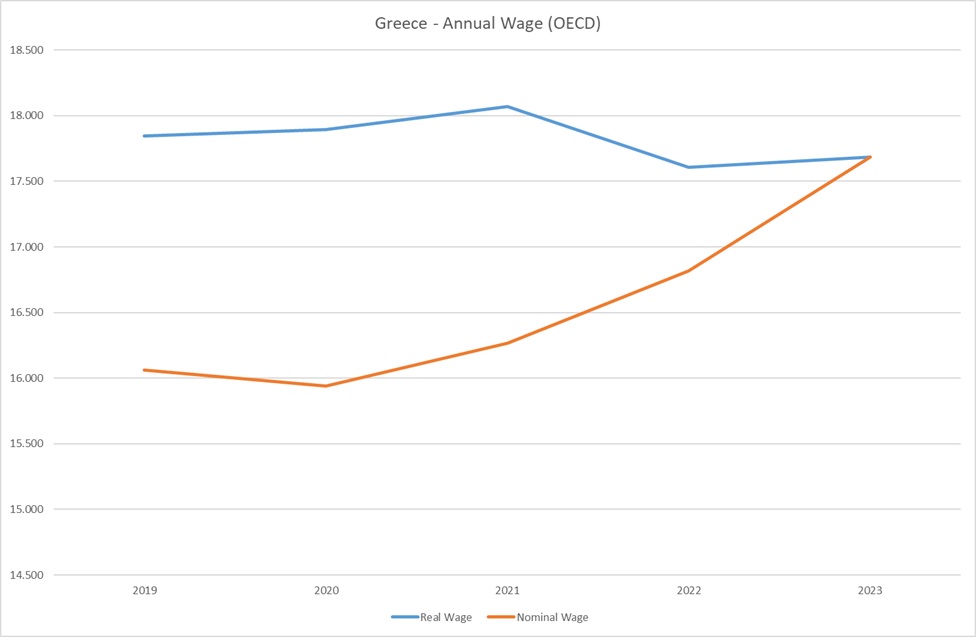
The negative picture of the course of real wages is also confirmed by data from the OECD and the European Union, which show that during the period 2019 – 2023 we had a decrease in the average real wage, indicating that for a long time workers saw real losses, and this picture was only reversed in 2024.
The course of the minimum wage
The government’s argument
The minimum wage is currently €880 per month, while when the New Democracy government came into power in 2019 it was €650 – an increase of 35.4%. This is the picture as of April 1, 2025, when the latest increase in the minimum wage took place. Before that, the minimum wage was €830, an increase of 27.7% compared to 2019.
The counterargument
Again, the nominal figure gives the impression of a large increase – almost 35%. If we take into account the inflation of the corresponding period, one can see that the real increase in the minimum wage is about 12% (until recently 8%) – an increase in real purchasing power by about €80 (until recently it was €50) per month compared to 2019.
However, the consumer price index is not the appropriate indicator to estimate the actual change in purchasing power for those on lower incomes. For them, a larger share of disposable income is spent on food, shelter and energy, where the increase in prices far exceeds that suggested by the consumer price index. So those on the minimum wage have faced a reduction in their real purchasing power.
Greece’s minimum wage relative to others
The government’s argument
Greece ranks 11th among the 22 countries in Europe that have a minimum wage[3].
The counterargument
The essential argument is that the ranking says absolutely nothing if we do not know how it relates to the cost of living. Simply put, to the extent that we do not know the cost of living of a Croat, the fact that we have about the same minimum wage does not help us to really understand whether we are in a better or worse position. A second factor that plays a role is the percentage of people who receive wages close to the minimum wage. Indicatively, according to ERGANI, about 31% of employees (full-time and part-time) receive up to €900 euros gross, while about 46% of employees receive less than €1,000 gross. It is therefore no coincidence that according to a recent survey by FHW GSEVEE, 6 out of 10 households (60%) stated that their monthly income is not sufficient for the whole month, and that they cannot cope at all, or can cope only with great difficulty, if hit with an unexpected but necessary expense of €500.
Conclusion
The systematic appeal to nominal values for wage increases by the government presents a misleading picture with respect to living standards in Greece over the last 5 years, one which is largely reversed if one takes into account the effect of inflation and even more so of inflation on basic needs such as food and housing.
It is indicative that the above picture has was confirmed by the Deputy Minister of National Economy and Finance, Mr. Petralias, when in the debate on the 2025 budget, he said that so far employees have had losses in income in real terms and that after 2025 there will be an improvement: “You will see that real net wages are starting to exceed the losses of inflation. This is not a process that takes place overnight. Yes, it took us in ’22, ’23 and ’24, three years for this to happen, so that in ’25 we would start to see real rewards on top of the losses we had.”
Of course, the next question that arises is whether these improvements can be maintained for a long period of time in order to reverse not only the losses of recent years but also the losses during the period of the structural adjustment programmes (2010-2018). For example, how much do wages have to rise for a young couple to have a realistic prospect of buying a house? Or how many years will it take for Greece to converge with the European average income per capita? A lot depends on the government’s promise for rapid growth in the coming years. We shall return to such issues in future posts.
References
[2] It is indicative that according to a survey by FHW GSEVEE, the top three items that households consistently continue to allocate most their income are household bills, food items, and heating,
[3] Even after the recent increase, the country remains in 11th place, as in recent months it had fallen to 14th, while since April 1st it is back in 11th