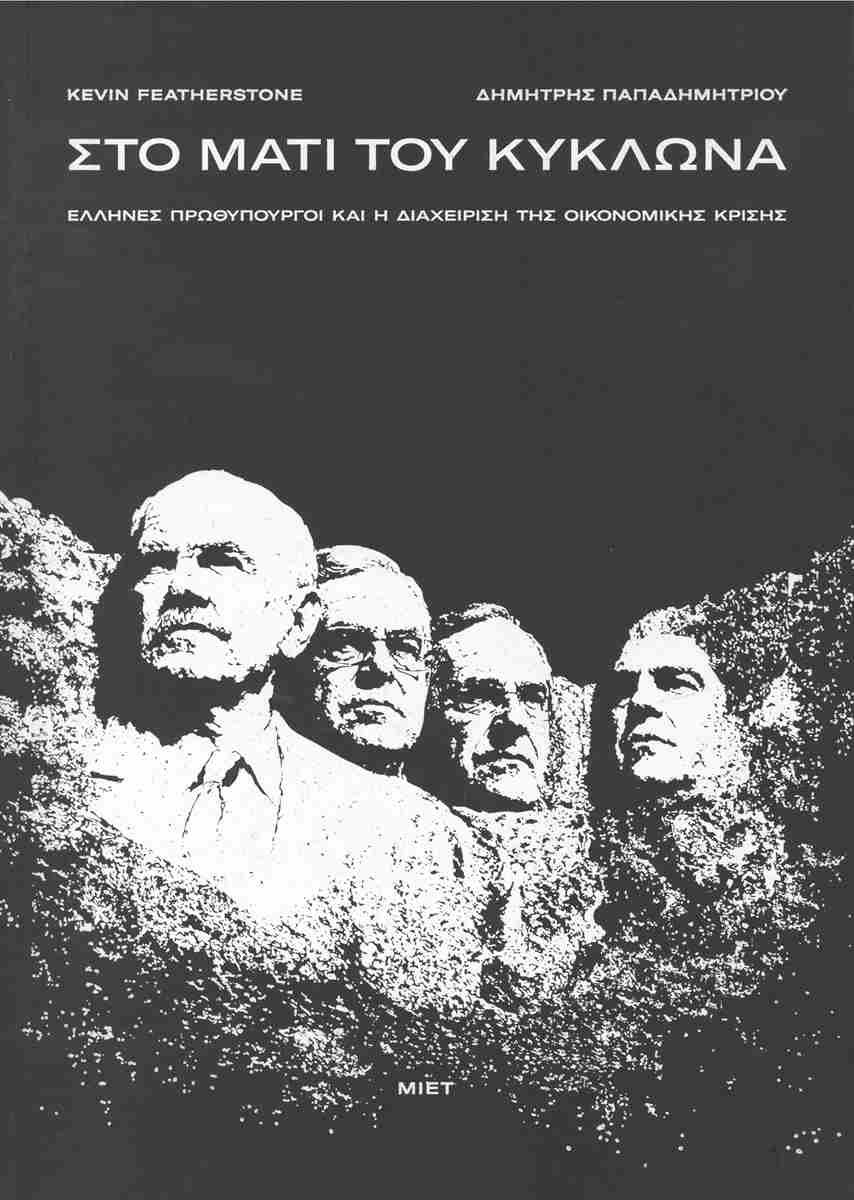
A review of Kevin Featherstone & Dimitris Papadimitriou: Greek Prime Ministers in the Eye of the Storm: crisis management and institutional change, OUP, 2025
Kevin Featherstone and Dimitris, two political scientists, have written an engaging and well researched book about the Greek crisis and the the response of successive governments in negotiating the three structural adjustment programmes. The strengths and weaknesses of the book stem from from their focus on institutional change, and their choice of not focusing on the success or failure of the programmes with respect to the consequences of these programmes for the economy and society.
First the successes. Throughout the book the authors set out three hypotheses, with Greece as a case study: the extent to which a strong leadership on the part of the prime minister can provide a centralised response to the crisis; the extent to which the crisis response network could lead to the same result to the degree to which it could gain cabinet acceptance; and, finally, whether implementing the programme could lead to institutional change within the structure of the core executive in favour of greater coordination. Simplifying greatly, the conclusion is that, to a greater or lesser extent, Greek prime ministers, at least some of the time, made progress with respect to the first two hypotheses, but little progress was made with respect to the third.
A key analytic concept throughout the book is the concept of the crisis response network (CRN), that is to say how the various governments set out to implement their commitment to the programmes, coordinating the office of the prime minister, the various ministers and a host of experts from public servants to outsiders. There is a great deal of information about how all four administrations set up their network, the goals set and the problems of implementation in practice. Future researchers will have much to learn from their discussion, including well set out tables showing the links within the network. It will, in short, become a standard reference book for years to come.
I will focus here on their main conclusion that while the leadership of the prime ministers, and their respective CRNs, managed at critical times to centralise and coordinate the core executive to implement the programmes – although, as they point out, only the SYRIZA government managed to complete and exit the programme – little progress was made in institutionalising such changes so that they could outlast the programmes – in their catching phrase, the CRNs “largely ‘floated’ above the administration”. Indeed, they argue that such institution building was only carried out by the post 2019 Mitsotakis government, a contentious claim to which I will return to later. As they point out the lack of coordination and centralisation of the core executive, as well as its ability to engage with long-term planning has a long history in Greece. In the opinion of the authors the institutions, representing Greece’s creditors, tried to change this path dependency but without much success. I am not so sure. The authors acknowledge that in crisis conditions officials must work “with limits of time, information, cognition, and risk”, but it can be argued that they underplay the element of time. My own experience is that the pressure of time on the part of the institutions to complete the prior actions, in order for disbursements to be released, was a strategic choice. In this context long-term institution building was hardly a priority.
But there is a further issue here. The need for fiscal adjustment entailed a severe reduction in the number of civil servants. This was in line with the neoliberal thinking of the times, shared by both the institutions and the Papademos and Samaras governments, and, of course, by Kiriakos Mitsotakis who in the Samaras government was responsible for administrative reform and was an enthusiastic supporter of smaller government. Featherstone and Papadimitriou could have gained much by including in their account Marianna’s Mazzucato’s work on the infantilisation of the state (in her book entitled the Big Con), the tendency of governments to rely on outside expert advice and consultancy firms that have little incentive to build up the capacities of the state or civil servants as this would affect the likelihood of them gaining the next contract. It is difficult to believe that the authors’ support for a more organized state could be seriously pursued in this context.
With respect to long-term planning, the issue can be put in starker terms. Implicitly the authors seem to suggest that the lack of a planning capacity in Greece is not only just long standing, but in some sense irrational. But the lack of planning has its advantages, in particular it allows a lack of clarity thereby enabling the continuation not only of the clientelistic state but of ad hoc deals with powerful private interests. At the end of chapter seven, the authors are rather ambiguous on whether Mitsotakis executive state after 2019 was an exercise in institutionalising the kind of centralisation and coordination of their third hypothesis. To their credit, they describe the view of critics: the incorporation of the state broadcasting company and the secret services within the office of the prime minister, the scandal of the phone taping of friends and foes, and the bullying of the ADAE hardly amount to to what most people would hope for from an executive state. To this we could add the executive state’s tendency to intervene in Parliament and the judiciary to cover up a succession of scandals.
But by chapter eight the overall assessment is far more sanguine, concluding that the kind of institution building they support was easier to implement after the crisis, and was indeed implemented by Mitsotakis. One of their examples for this more upbeat assessment was the approval of the EU of the Mitsotakis’ government approach to the RRF. But this seems to me a serious misunderstanding. Not only did the government not prepare its plan after consultation with the wider society, as the EU directive required and as other governments (for instance the Draghi government in Italy) pursued, but a significant share of the finance available went to the government’s preferred large businesses – crony capitalism taken to another level. As for so many other Greek administrations the lack of planning, the lack of clarity, was not irrational – it was an integral part of their approach in building their support base.
Here we come to another ideological stance shared by both the institutions and the governments of both Papademos and Samaras. Public choice theory, an integral component of neoliberalism, has supported a smaller government supposedly to protect the state, and politicians, from undue private interests. In practise, the theory has been used to protect the state from popular concerns – the influence of strong private interests (finance, MNCs, BigTech etc.) within governments has increased in the period of neoliberalism. From my own experience, the institutions were consistently bringing to the negotiating table positions that were being demanded by such interests. Needless to say, the voice of workers, social movements and others facing the consequences of the programmes was much much weaker.
Here the position of the SYRIZA government is distinct. The authors in various instance argue that the implementation of the programmes were more or less uncontested. On the other hand, they do refer to SYRIZA’s three basket approach: the first having to do with agreed items that should be implemented as quickly as possible, the second with contentious issues to be negotiated, and the third with matters outside the remit of the programme. But for us, the second basket was critical: an attempt, at times successful at times less so, to limit the most anti-social elements of the programmes and provide space for interventions that could bring relief to those that had suffered most in the previous programmes. In this way, in 2019 the level of inequality and poverty (including child poverty) had been reduced, and the national health system had made significant advances – a remarkable achievement under programme conditions.
It has been argued that after the WWII, Germany and Japan were able to recover from the war as quickly as they did because the war had destroyed their old elites. The Greek crisis does not seem to have led to a similar outcome. The Greek elites that led us into the crisis are as strong, perhaps stronger, than they ever were. It is no exaggeration to say they are embedded within all levels of the state. Perhaps this is the biggest failure of SYRIZA government. And perhaps this is not surprising. The Left’s theorising in areas such as the economy or ideology is far stronger than its approach to administrative institution building. What is needed is a core executive that is not isolated from the demos.